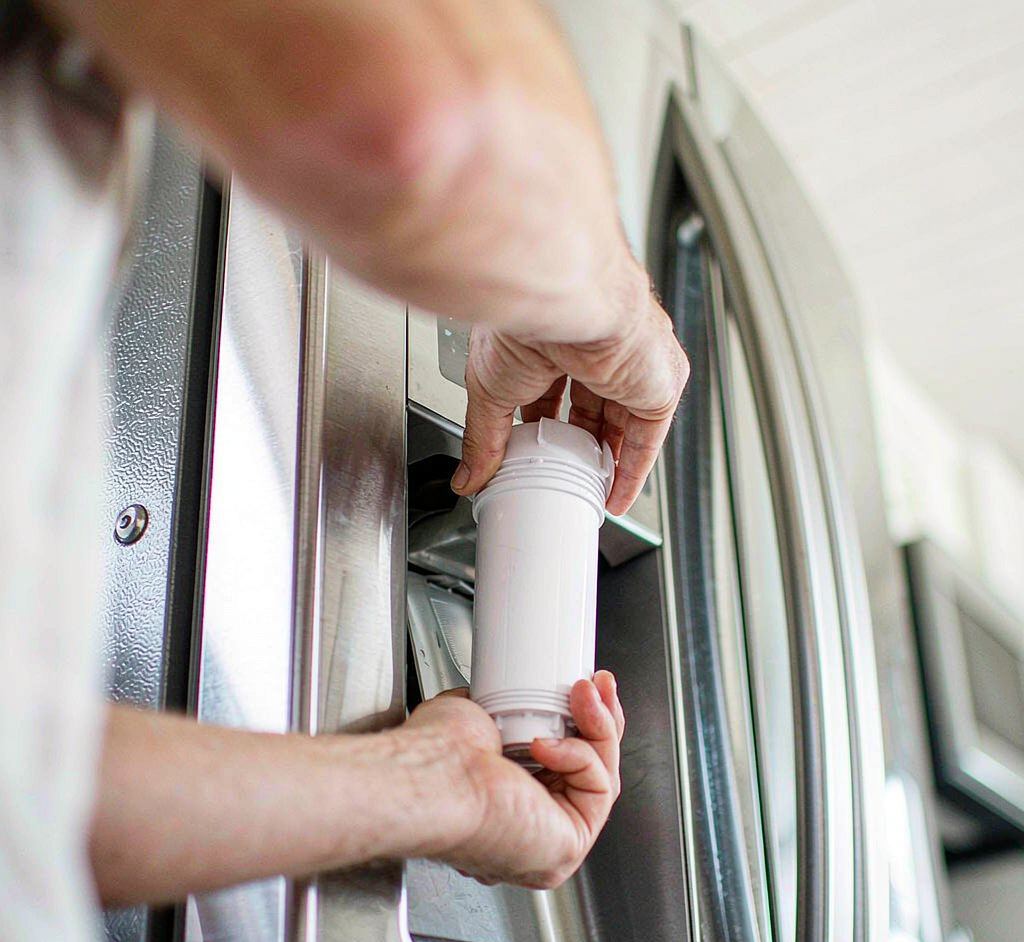
everydrop Filter 1, the shorter cartridge used in a large share of Whirlpool side-by-side and top-freezer refrigerators.
Filter 1 is the most common Whirlpool-family twist-in cartridge, and the aftermarket market around it is mature: you are choosing between three well-established replacement brands, not gambling on no-name listings.
Buy this if: Buy the Waterdrop 3-pack if your household goes through a filter every six months — it lands near $8 per cartridge, cheaper per unit than every single-pack option here. Pick Waterdrop Plus if pharmaceutical-adjacent reduction (NSF/ANSI 401) matters to you and you accept paying roughly double. Glacier Fresh is the sane choice if you want a single filter today and the lowest shelf price.
Skip it if: Skip this page entirely if your refrigerator takes a push-in filter located in the base grille — Filter 1 is a twist-in cartridge that sits inside the fresh food compartment. And if you insist on a Genuine Whirlpool part, this catalog does not currently carry a priced OEM listing for it; buy from Whirlpool directly rather than trusting a listing that claims OEM at aftermarket prices.
The numbers that actually matter
That is the rated capacity Waterdrop prints for its Filter 1 replacement — the volume the cartridge is tested to filter before its carbon block is considered spent.
A household that dispenses roughly a gallon a day — drinking water, coffee, a filled pet bowl, rinse water — lands right at the six-month mark. Two adults who mostly drink coffee brewed with kettle water might stretch a cartridge far beyond the calendar date without ever noticing a difference.
When it becomes a problem: Well water or a municipal supply with heavy sediment loads up fine particles can blind the carbon block's outer layer early. If your glass starts tasting flat again at month three, the cartridge is spent even if the calendar says otherwise — trust the water, not the sticker.
The calendar half of the rating. It exists because carbon degrades with contact time even when volume is low.
Set one reminder per year for a two-pack, not six for six filters. The two-pack at $19.54 covers a full year at the six-month cadence and undercuts buying two single filters at $15.99 each.
When it becomes a problem: The failure mode of the calendar interval is quiet: nothing breaks, the water just slowly tastes like tap again. If your fridge has a filter-status light, trust it over the calendar — it estimates flow, not days.
The arithmetic of the $23.74 Waterdrop 3-pack divided by three — the real unit cost once you commit to a year and a half of filters.
Every single-pack option on this page costs more per cartridge: $15.99 Waterdrop, $19.99 Glacier Fresh. The 3-pack is the whole price advantage of aftermarket Filter 1 in one number.
When it becomes a problem: It is only a saving if you actually use all three. If you are moving, replacing the fridge, or switching to a push-in system, the 2-pack at $19.54 ($9.77 per cartridge) is the better hedge — nearly the same unit price, half the commitment.
The certification tier carried only by Waterdrop Plus in this lineup. It covers reduction of trace compounds that standard aesthetic certifications do not — the listing names phenytoin, naproxen, estrone and bisphenol A as tested compounds.
If your reason for filtering goes beyond taste — a concern about trace contaminants in the municipal supply — 401 is the tier that addresses it, and it is why the Plus 3-pack costs $41.99 instead of $23.74.
When it becomes a problem: The standard tier (NSF 42 & 372) makes no such claim: 42 covers taste and chlorine aesthetics, 372 covers lead-free material in the housing. Neither says the cartridge reduces pharmaceutical compounds. Paying standard-tier money while expecting 401 performance is the most common mismatch in this category.
The physical envelope of the cartridge. Filter 1 housings are molded to this shape — a quarter-turn twist locks the top threads and seats the O-ring.
It is the fastest visual pre-check before ordering: pull your old cartridge out and compare. If what you are holding is wider, shorter, or push-in rather than twist-in, you are not holding a Filter 1.
When it becomes a problem: Whirlpool family housings across Filter 1 through Filter 4 look superficially similar from the store shelf. Length and cap shape are the tell — a Filter 3 cartridge will not seat in a Filter 1 housing no matter how similar the photos look.
About this cartridge
W10295370A remains the number printed on most refrigerators that take this cartridge, even though the retail name is now Filter 1. It is shorter than Filter 4 and uses a different collar.
Certified to 42 and 53 at 200 gallons. Because the housing is often in the base grille, replacing it means opening a grille panel at floor level rather than reaching into the fridge.
What the certifications cover
- NSF 372 on every listing here certifies the materials are lead-free — it is a materials standard for the housing and components, not a claim about lead reduction in your water. If lead reduction is your concern, you need NSF/ANSI 53, which only the Waterdrop Plus tier carries in this lineup.
- Flush two to three gallons through the dispenser after install. The first glasses after a cartridge swap routinely carry loose carbon fines; that is normal and clears with flushing, but skipping the flush is the most common cause of 'new filter makes water cloudy' complaints.
- All three brands here are aftermarket parts. They are not manufactured or endorsed by Whirlpool. If your refrigerator is under warranty and a dealer has told you aftermarket parts void it — that claim has no basis for consumable filters, but confirm with Whirlpool directly if it worries you.
- Do not run the dispenser with the cartridge removed to 'get one more week'. An unfiltered bypass path defeats the entire point and can pull sediment into the water line.
What it won’t do
- A carbon block cartridge does not remove dissolved minerals, so it does not soften water or reduce total dissolved solids (TDS). Hard water spots on ice cubes are a plumbing characteristic, not a filter failure.
- It does not fix contamination upstream of the filter — sediment from a corroded household line will exhaust a $8 cartridge as fast as a $40 one. If your old cartridges come out visibly muddy, the problem is before the fridge, not in it.
- Cloudy but clears-left-to-right ice is usually trapped air, not contamination. A filter change will not change it; a water-chemistry test will tell you if anything is actually wrong.
- Certifications cover the cartridge as tested. They do not transfer to an installation where the cartridge is past its rated 200 gallons — an exhausted carbon block can shed what it once captured.
- None of these listings claims cyst or microbial reduction. If your water has a boil notice, a fridge filter of any tier is not the mitigation.
Also sold as
These part numbers refer to the same physical cartridge. If the number on your old filter is in this list, this is the right replacement.
Not interchangeable with Filter 4 / UKF8001.
Which refrigerators it fits
Whirlpool has not published a model-level list for this cartridge that we can verify, so we do not publish one either. The number on the cartridge you are removing is the reliable check.
Look up your refrigerator
Find the model sticker and search it here.
Browse refrigeratorsAll Whirlpool filters
Compare the cartridges in this housing family.
Open WhirlpoolReplacing it
- Turn the old cartridge a quarter turn counter-clockwise and pull it straight out. Keep a towel under it — a few ounces of water will come out.
- Remove the protective cap from the new cartridge and check that the O-rings are seated flat in their grooves.
- Push it in and turn clockwise until it stops. Run two to three gallons through the dispenser to flush carbon fines, then reset the indicator.
Common questions
Does the EDR1RXD1 fit my Whirlpool refrigerator?
How often do I need to replace the EDR1RXD1?
Is W10295370A the same filter as EDR1RXD1?
Can I use an aftermarket 1RXD1 replacement?
Is the Waterdrop Plus worth double the standard Waterdrop?
Why do Waterdrop listings show different review counts for the same filter?
My fridge takes Everydrop Filter 1 — is that a different cartridge?
What happens if I run a filter past 200 gallons?
EDR1RXD1 vs the rest of the Whirlpool family
Whirlpool's twist-in family splits by filter number, and the number is printed on your old cartridge — match it, not the fridge's look.
| Cartridge | Where it lives | How to decide |
|---|---|---|
| EDR1RXD1 (Filter 1 / W10295370A) | Twist-in, inside the fresh food compartment | This page. The most common Whirlpool-family cartridge — if your old filter says W10295370A or Filter 1, this is your lane. |
| EDR2RXD1 (Filter 2 / W10413645A) | Twist-in, different housing | For fridges that specify Filter 2. Same quarter-turn motion, different cartridge length and cap — not interchangeable with Filter 1. |
| EDR3RXD1 (Filter 3 / 4396841) | Twist-in, base-grille era housings | Older Whirlpool-side fridges. If your filter lives in the base grille rather than the fridge interior, check Filter 3 before buying here. |
| EDR4RXD1 (Filter 4 / UKF8001) | Twist-in, inside compartment | Common on Maytag-built units. Rated 300 gallons versus Filter 1's 200 — a different cartridge despite the similar shape. |
Prices, pack sizes, ratings and review counts: captured Amazon listing data for the seven offers currently on this page. Capacity and service life: Waterdrop listing copy (200 gallons / 6 months). Certification tiers: listing-stated NSF 42 & 372 (standard) and NSF/ANSI 401 & 53 & 42 (Plus, IAPMO-tested per listing). Fit family: catalog alt-code cross-references.